Yellow sapphire
Yellow sapphire combines the glow of a yellow stone with the hardness of corundum. It is sought after in jewellery and, in the Vedic tradition, under the name Pukhraj.
Maiwis editorial team
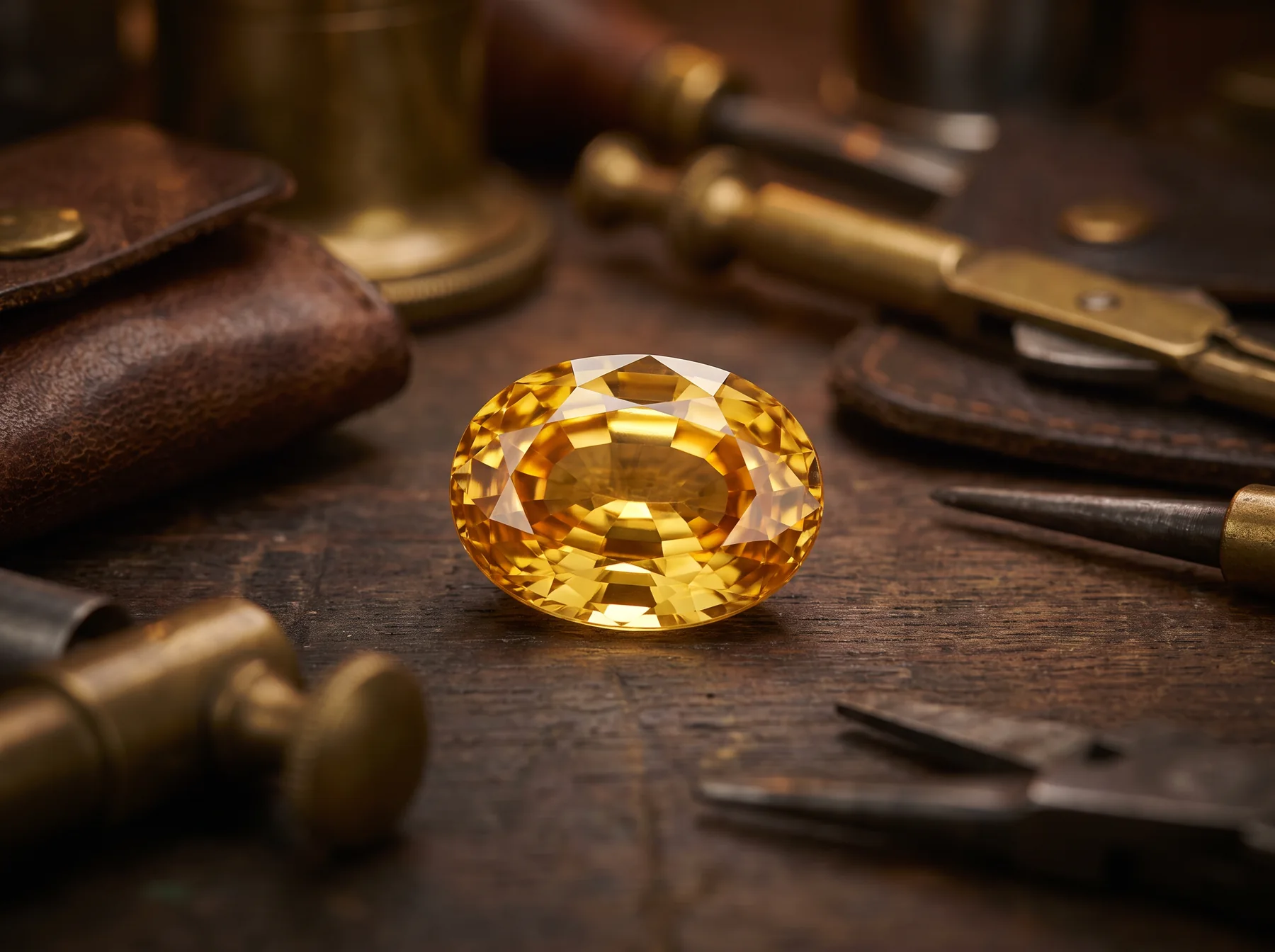
What gives a yellow sapphire its value
| Criterion | What we look at |
|---|---|
| Colour | A vivid, saturated yellow, from lemon to golden yellow. Brownish or greenish tinges lower the value. |
| Clarity | Yellow sapphire is often very clean. We expect a stone with no inclusion visible to the naked eye. |
| Cut | A well-proportioned cut reveals the brilliance of the stone and avoids pale zones. |
| Weight | Yellow sapphires of several carats are easier to find than blues of the same quality, which makes them accessible. |
| Treatment | Unheated, heated or diffused. This is the line of the report that weighs most. |
Origins
Sri Lanka is the most renowned source of yellow sapphires, with luminous stones in pure shades. They are also found in Thailand and Laos, as well as in Madagascar and Tanzania. Origin is an expert opinion, established by the laboratory.
Treatments
Heating is common and accepted for yellow sapphire, provided it is disclosed. Beryllium diffusion is of a different nature: it introduces a foreign element into the crystal to create or intensify the colour. It has been widespread on yellow and orange sapphires. Only laboratories equipped with fine chemical analysis instruments detect it with certainty, which is why the choice of laboratory matters.
Yellow sapphire in the Vedic tradition
In Vedic astrology, yellow sapphire, called Pukhraj, is one of the nine stones of the tradition and is associated with Jupiter. Those who choose it for this reason generally ask for a natural, unheated stone, accompanied by its report.
We present this place of yellow sapphire as a cultural heritage. We attribute no effect to stones, and we describe each one solely from its laboratory report.
Choosing a yellow sapphire
For a jewel, look for a pure, luminous yellow with no brown. For a stone chosen for tradition, require a statement of no heating on the report of a laboratory able to detect diffusion.
Yellow sapphire: the weight and cut you choose
The House does not hold a fixed stock. You describe what you are looking for, we search through our sources and present a short selection.
The weight
From a few tenths of a carat up to major collector pieces. Give us a range, for example 2 to 3 carats.
The cut
Oval, cushion, emerald cut, round, pear, heart, radiant or cabochon: the shape is chosen according to the jewel you will have made.
The colour
The shade, the intensity and the treatments you accept or exclude. The more precise the request, the faster the search.
As soon as a stone matches, we send you its photographs, a video, its laboratory report and its price, with no obligation. You then decide. The House supplies the exceptional stone; the jewel is made by the jeweller of your choice. Orders are taken worldwide, and stones can be viewed in person in Paris, by appointment.
Place an orderFrequently asked questions
Yellow sapphire or citrine: what is the difference?
Citrine is a quartz, markedly softer and much less expensive. To the eye the two stones can look alike. The laboratory report establishes the nature of the stone.
Why does the Vedic tradition prefer an unheated stone?
It is the custom in this tradition, which favours a stone left as nature formed it. We present this choice as a cultural practice, without attributing any effect to it.
What is beryllium diffusion?
A very high-temperature treatment that introduces beryllium into the crystal to change its colour, notably towards yellow and orange. It changes the value of the stone and must be disclosed.
Where do the finest yellow sapphires come from?
Sri Lanka is the most renowned source. They are also found in Thailand, Laos, Madagascar and Tanzania. Origin is established by the laboratory.