Emerald
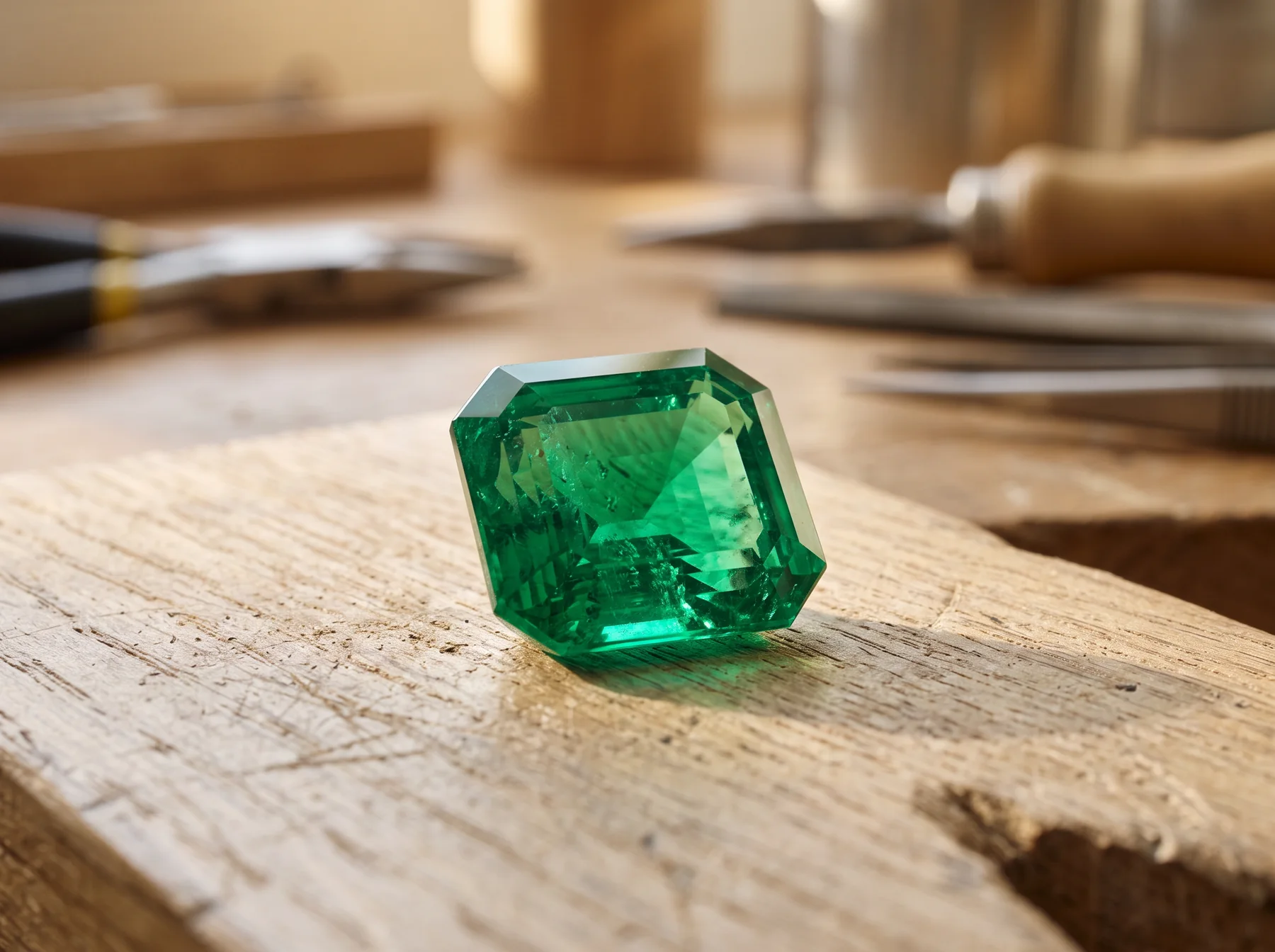
Emerald is the green variety of beryl. It is judged first on its colour, then on its garden, the inclusions that tell the story of its formation and also make it more fragile.
Maiwis editorial team
What gives an emerald its value
| Criterion | What we look at |
|---|---|
| Colour | An intense, luminous green, neither too light nor too dark. By far the most important criterion. |
| Clarity | The garden is expected. We avoid fissures that reach the surface, because they weaken the stone. |
| Treatment | The presence of oil or resin, and its degree. Swiss laboratories use a scale running from “none” to “significant”. |
| Cut | The emerald cut, with its stepped corners, protects the angles of this knock-sensitive stone. |
| Weight | Fine emeralds above a few carats are rare, especially with a minor treatment. |
| Origin | Colombia, Zambia, Brazil: origin matters, but less than colour. |
Origins
Colombia, with the Muzo and Chivor mines, is the historical benchmark for emerald. Zambia, in the Kafubu region, has become one of the world’s major sources. Its emeralds, richer in iron, often have a slightly bluish green and fine transparency.
Emeralds are also found in Brazil, Zimbabwe, Afghanistan and Ethiopia. As with all stones, origin is established by a laboratory, from the inclusions and the chemical composition.
Treatments
Emerald is almost always treated. Its fissures are filled with an oil, traditionally cedar oil, or with a resin, to make them less visible. This treatment does not change the nature of the stone, but it changes its appearance, and therefore its value.
The report states the nature of the substance and how much of it there is. An emerald with no treatment at all, of fine colour, is a collector’s stone. A coloured oil, which alters the hue, is a separate treatment and must be reported.
Choosing an emerald
Look at the colour first, then at the liveliness of the stone. A discreet garden takes nothing away from an emerald, it is its signature. Check the degree of treatment on the report, and prefer a setting that protects the stone if it is to be worn often.
Emerald: the weight and cut you choose
The House does not hold a fixed stock. You describe what you are looking for, we search through our sources and present a short selection.
The weight
From a few tenths of a carat up to major collector pieces. Give us a range, for example 2 to 3 carats.
The cut
Oval, cushion, emerald cut, round, pear, heart, radiant or cabochon: the shape is chosen according to the jewel you will have made.
The colour
The shade, the intensity and the treatments you accept or exclude. The more precise the request, the faster the search.
As soon as a stone matches, we send you its photographs, a video, its laboratory report and its price, with no obligation. You then decide. The House supplies the exceptional stone; the jewel is made by the jeweller of your choice. Orders are taken worldwide, and stones can be viewed in person in Paris, by appointment.
Place an orderFrequently asked questions
Is an oiled emerald a fake emerald?
No. Oil does not change the nature of the stone, it makes the fissures less visible. It is an old and very widespread practice, which must be disclosed with its degree.
Zambian or Colombian emerald: which to choose?
It is first a matter of taste. Colombian emeralds often have a warmer green, Zambian ones a cooler, slightly bluish green. The quality of the stone matters more than its origin.
How do I care for an emerald?
Avoid ultrasonic cleaners, steam and knocks. A soft cloth and lukewarm water are enough. A jeweller can renew the oil of an emerald if needed.
Can an emerald be worn every day?
Yes, with some care. Its hardness is high, but its inclusions make it sensitive to knocks. For a ring, a protective setting such as a bezel is advisable.