A laboratory report describes a stone. It does not value it. No major laboratory states a price in it, and that is precisely what gives it its worth: an independent view, with no stake in the sale.
The reference laboratories
For top-quality coloured stones, a few names carry authority on the international market. The Swiss laboratories SSEF and Gübelin, the GRS laboratory and GIA are the most cited. In France, the Laboratoire Français de Gemmologie, in Paris, is the reference.
For a major piece, it is not unusual to gather the reports of two different laboratories. The most demanding buyers see this as a confirmation, notably of origin.
What the report contains
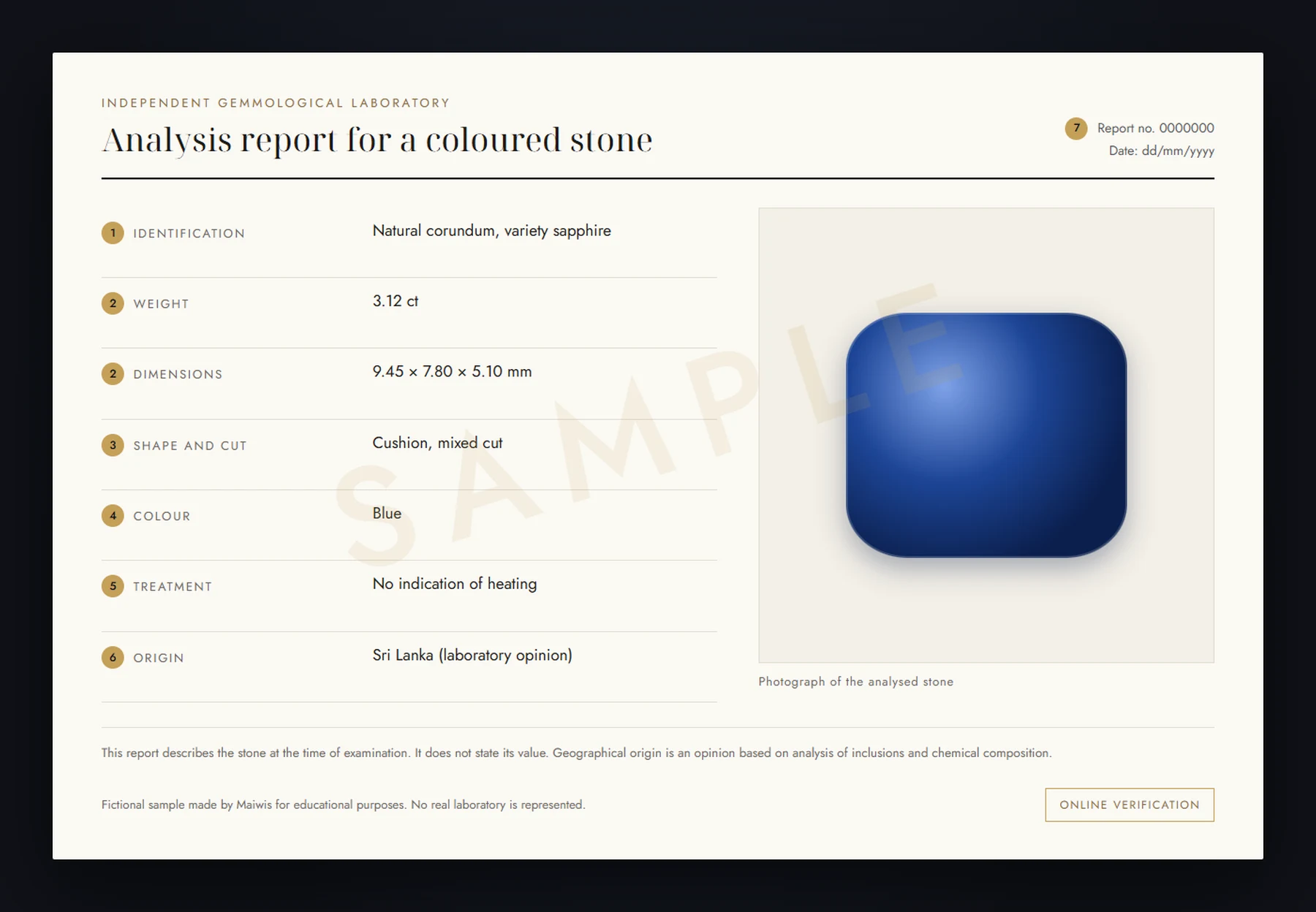
| Section | What it states | Why it matters |
|---|---|---|
| 1. Identification | The nature of the stone: natural corundum for a sapphire or ruby, beryl for an emerald | It separates a natural stone from a synthetic or an imitation |
| 2. Weight and dimensions | The weight in carats, to the hundredth, and the measurements in millimetres | They tie the report to the stone you are holding |
| 3. Shape and cut | Oval, cushion, emerald, pear, and the cutting style | They describe the stone without judging the quality of the cut |
| 4. Colour | A description, sometimes a reserved name such as “royal blue” | These names follow each laboratory’s own criteria |
| 5. Treatment | No indication of heating, heating, residues, diffusion, or for emerald, the presence of a substance in the fissures | This is the line that weighs most on value |
| 6. Origin | Sri Lanka, Burma, Madagascar, Colombia… | An expert opinion, based on inclusions and chemical composition |
| 7. Number and date | The report identifier, with a photograph of the stone | It is used to verify the authenticity of the document |
What the report does not say
It says nothing about price. Nor does it judge the beauty of a cut with the finesse of a trained eye, or how the stone behaves in daylight. Two sapphires with identical reports can make a very different impression.
This is why we always present a stone on video, under several lights, before any decision.
Verifying a report
Most of the major laboratories offer online verification from the report number. It lets you confirm that the document is authentic and that its measurements match the stone.
For a major purchase, prefer a recent report. The stone may have been recut since, and analysis methods keep progressing.
At Maiwis, every stone is presented with its report, and its number can be verified before purchase.
Frequently asked questions
Which laboratory should I choose for a sapphire or a ruby?
For top-quality coloured stones, the Swiss laboratories SSEF and Gübelin, as well as GRS and GIA, are the most recognised on the international market. In France, the Laboratoire Français de Gemmologie is a reference.
Does a laboratory report state the value of the stone?
No. A laboratory report identifies and describes the stone. Estimating its value is a separate expertise.
Does an old report remain valid?
It remains valid for the stone as it was at the time of examination. For a major purchase, a recent report is preferable, because the stone may have been recut and analysis methods have progressed.
What do “royal blue” or “pigeon blood” mean on a report?
They are colour names that some laboratories reserve for stones that meet their own criteria. They are not standardised between laboratories.