Blue sapphire
Blue sapphire is the most sought-after coloured stone in fine jewellery. Its value rests on a few precise criteria, which the laboratory report allows you to verify.
Maiwis editorial team
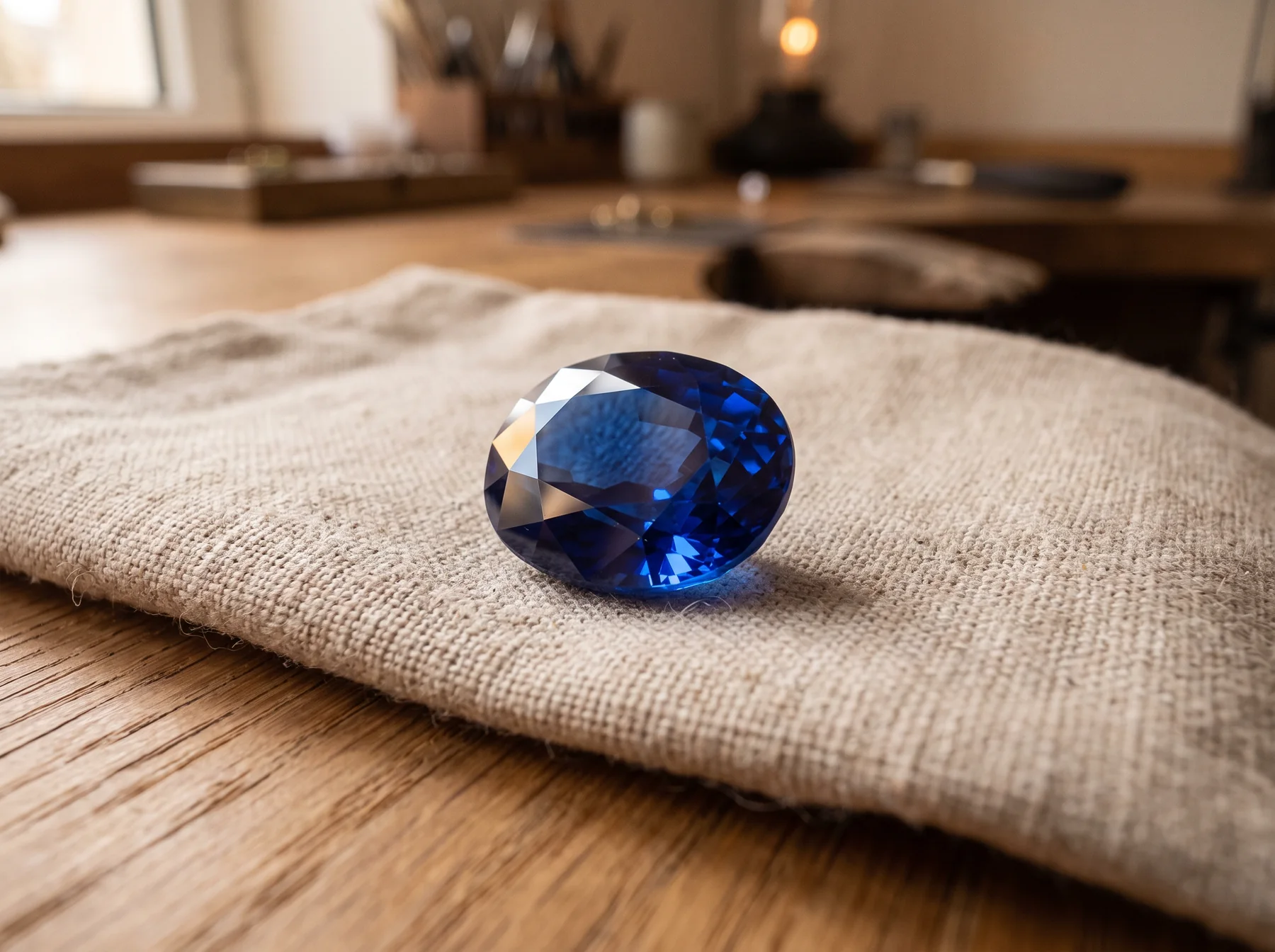
What gives a blue sapphire its value
| Criterion | What we look at |
|---|---|
| Colour | Hue, saturation and tone. The sought-after blue is pure and intense, without marked grey or green. |
| Clarity | Inclusions visible to the naked eye. Fine rutile needles, known as silk, can soften the colour. |
| Cut | The regularity of the facets and the way the stone returns light, with no dull area at the centre. |
| Weight | The price per carat rises with size, because fine stones above 3 carats are far rarer. |
| Treatment | Heated or unheated, according to the report. The price gap can be significant. |
| Origin | At equal quality, a renowned origin such as Sri Lanka or Kashmir weighs on the value. |
Origins
Blue sapphire forms in several regions of the world. Sri Lanka, formerly Ceylon, has produced luminous blues for centuries. Madagascar has become a major source since the late 1990s.
In South-East Asia, Thailand, Cambodia and Laos have yielded sapphires of often darker blues, linked to deposits of basaltic origin. The sapphires of Kashmir, with their velvety blue, remain the historical benchmark, but their deposits were exhausted long ago.
Origin can never be read by eye. A laboratory establishes it from the stone’s inclusions and chemical composition, and it remains an expert opinion.
Treatments
Most blue sapphires on the market have been heated to intensify their colour and improve their transparency. This treatment is stable and accepted by the trade, provided it is disclosed. Other treatments, such as diffusion, alter the stone and its value far more. The article Heated or unheated sapphire explains these differences.
Choosing a blue sapphire
For an engagement ring, a heated sapphire of fine colour offers an excellent balance between beauty and budget. For a collector’s piece, we favour an unheated stone, accompanied by the report of a leading laboratory, sometimes two.
In every case, the stone is also judged by eye. A video under several lights often says more than a photograph.
Blue sapphire: the weight and cut you choose
The House does not hold a fixed stock. You describe what you are looking for, we search through our sources and present a short selection.
The weight
From a few tenths of a carat up to major collector pieces. Give us a range, for example 2 to 3 carats.
The cut
Oval, cushion, emerald cut, round, pear, heart, radiant or cabochon: the shape is chosen according to the jewel you will have made.
The colour
The shade, the intensity and the treatments you accept or exclude. The more precise the request, the faster the search.
As soon as a stone matches, we send you its photographs, a video, its laboratory report and its price, with no obligation. You then decide. The House supplies the exceptional stone; the jewel is made by the jeweller of your choice. Orders are taken worldwide, and stones can be viewed in person in Paris, by appointment.
Place an orderFrequently asked questions
Is a blue sapphire suitable for a ring worn every day?
Yes. Sapphire is one of the hardest stones after diamond, which makes it an excellent choice for an engagement ring.
Is a very dark sapphire worth more?
Not necessarily. A blue that is too dark loses its brilliance and looks almost black in low light. The finest stones combine intense saturation with a medium tone.
What is a Ceylon sapphire?
A sapphire originating from Sri Lanka. These stones are known for their luminous blues, often a little lighter than those of other origins. Origin is established by the laboratory.
Do Kashmir sapphires still exist?
The Kashmir deposits produced mainly in the late 19th century. Their stones are now extremely rare and are found almost exclusively at collection auctions.